Biodiversity Caucus - Winter 2026 Newsletter |
Message from the Caucus Co-Chairs
RCEN’s Biodiversity Caucus is starting 2026 with exciting news and renewed momentum. We are pleased to welcome our new CICan Internship–sponsored intern, Rose Harimi, who will be supporting the caucus’s coordination and research work until March 31, 2026. RCEN is also delighted to welcome back Fatma Ratansi, who is returning to assist with outreach and coordination across the network.
In December, the Caucus Co-Chair attended Environment and Climate Change Canada’s Environmental Justice webinar, part of the federal process to develop a national strategy on environmental racism and environmental justice under recently adopted legislation. Key resources from this work include ECCC’s Indigenous engagement materials and environmental justice portal, as well as information on the emerging right to a healthy environment under the Canadian Environmental Protection Act. Click here for more information.
RCEN’s networked model helps bring our Caucus's commitments to life by connecting groups who are defending ecosystems and communities across Canada. To support this work, consider donating to our Season of Connection campaign.
The Caucus provides a collective voice for organizations, offering guidance to national environmental groups, governments at all levels, the private sector, international organizations, and multilateral environmental agreement secretariats. Grounded in the CBD's definition of biological diversity, we emphasize genetic, species, and ecosystem diversity while respecting diverse belief systems and political views.
If you have any questions or wish to contribute to our projects, drop us a line at biodiversity@rcen.ca
Rosalind Warner and Frédéric Perron-Welch
|
|
Summary
This is an initiative of RCEN's Biodiversity Caucus that aims to transform and mobilize findings from the Intergovernmental Science-Policy Platform on Biodiversity and Ecosystem Services (IPBES) to create accessible knowledge and actionable items for Canadian civil society. One of the barriers to biodiversity protection is how civil society understands and prioritizes environmental connection. Understanding how human life and biodiversity are intrinsically connected helps to contextualize and prioritize actions that promote the protection, restoration, and improvement of natural ecosystems.
By reframing biodiversity as a foundation for sustainable life and a cause worth protecting rather than a constraint on our lives, this project seeks to mainstream IPBES knowledge and foster collaboration across sectors and worldviews.
Canada’s commitments under the Global Biodiversity Framework (GBF) call for “whole-of-society” approaches — meaning that not just policymakers, but all actors (industry, civil society, Indigenous nations, youth) are part of implementing solutions to build a sustainable future.
This project supports the IPBES’s core missions by facilitating access to knowledge and supporting decision-making across governments and organizations. This is accomplished by:
- Translating IPBES science into accessible, actionable forms for audiences outside of policy and academia.
- Engaging sectors that are agents of transformation (i.e. finance, business, faith groups, educators, civil society).
- Building communication models that help people understand their role in systemic change.
Objectives
- Increase accessibility and understanding of IPBES biodiversity assessment findings across diverse Canadian audiences.
|
|
- Support cross-sector learning on biodiversity and important emerging themes, emphasizing collaboration, shared responsibility, and opportunity.
- Develop adaptable engagement models that connect science, policy, and community voices in Canada.
Key Activities
- Common-Language Summary: Translate IPBES Transformative Change findings into an accessible, reviewed document for general and professional audiences.
- Public Engagement Materials: Create infographics, briefs, webinars, podcasts, or digital content for public and sectoral outreach.
- Citizen Science and Knowledge Integration: Explore pathways for community data and non-academic sources to help fill biodiversity information gaps.
- Community of Practice Development: Lay groundwork for a Canadian network linking ENGOs, academia, government, Indigenous knowledge holders, youth, and business leaders.
- Education and Outreach Tools: Design communication resources suitable for schools and community programs to strengthen biodiversity literacy.
- Sector-Specific Toolkit Plan: Draft practical guidance for sectors such as finance, industry, and faith-based groups to align their activities with biodiversity goals.
Expected Outcomes
- A stronger bridge between science, policy, and society through accessible information and knowledge sharing.
- Continue building foundations for a Canadian Community of Practice on Biodiversity Communication.
Improved engagement with diverse sectors (i.e. finance, faith-based communities) to promote environmental accountability and action.
- Integration of biodiversity learning and protection into educational settings and public life.
- A replicable communication model for use across IPBES national and regional networks.
|
New Report from Atelier Pour La Biodiversité
Toward a Quebec Economy in Harmony with Nature. The report highlights key discussions, insights, and actions identified by nearly 100 participants from across sectors who took part in the Economy, Biodiversity, and Transformative Change dialogue day in September 2025. The report is in French, but an English summary of the main learnings is available on the webpage.
|
Managing Biological Invasions: the Cost of Inaction
As we know, invasive species can have severe and unpredictable effects on biodiversity. In fact, a huge proportion of modern animal extinctions (roughly half) are caused at least in part by biological invasions. This study encourages early intervention on biological invasions by demonstrating a huge financial incentive, quantifying the cost in dollar values. They estimate cost of the damages alone as well as the cost of managing the invasive species, finding that the cost of management can increase by billions of dollars when intervention is delayed. The article is quite technical but I hope some of the information will be of interest to you.
|
Upcoming Meetings & Events |

|

|
Regenerate Forest and Wildlife Youth Summit
April 16-19, 2026
Inside Education is Alberta’s largest environment and natural resource education nonprofit, and we are excited to announce the return of the Regenerate Forest & Wildlife Youth Summit, being held April 16-19, 2026, in Canmore, Alberta!
This will be Inside Education’s 16th provincial-scale youth summit and offers a one-of-a-kind opportunity for high school students and teachers to come together and explore the issues, innovations, technology, and careers involved in managing Alberta’s forests and wildlife. The ultimate goal of the program is to connect young people with multiple perspectives on the forest topics and themes shaping the future and to inspire them to be responsible stewards of our environment, economy, and society.
Twenty teams from across Alberta receive full scholarships to travel to Canmore and take part in this program. They will then return to their schools and initiate an environmental action project to share what they have learned at the summit and encourage them to pursue environmental leadership in their communities.
Alberta teachers are invited to apply at www.regener8summit.ca by January 16 or email Natalie Graveline at ngraveline@insideeducation.ca to learn more! |
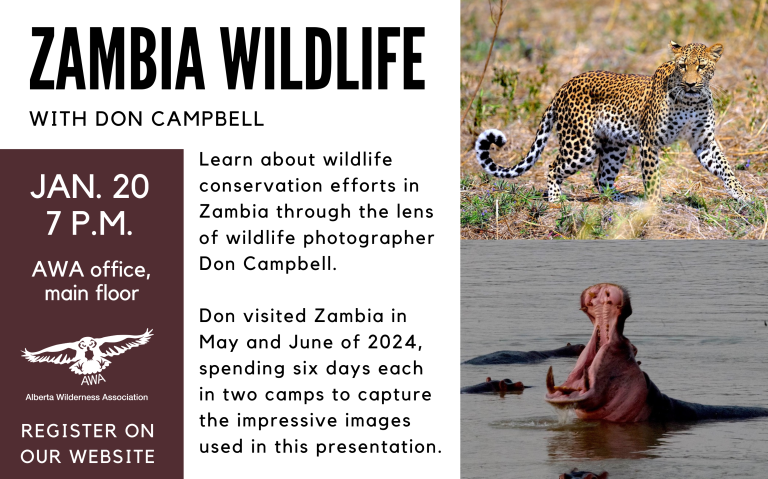
AWA Talk Night – Zambia Wildlife
The presentation will be by a photographer and cover conservation in Zambia, specifically some of the vehicle limits they have in place. The presentation will be broadcast virtually, for anyone who is interested in joining in. Registration is here: https://albertawilderness.ca/product/awa-talk-night-zambia-wildlife/.
Feel free to also check out our event listing here: https://albertawilderness.ca/events/ |
Spotlight: Raincoast Conservation Foundation
by: RCEN Biodiversity Steering Committee Member Kristen Walters, Director of Salmon Habitat, Climate, and Policy
Raincoast Conservation Foundation is a science-based registered charity that applies a unique model of informed advocacy to protect the lands, waters, and wildlife of British Columbia. Led by a team of conservationists and scientists, Raincoast’s projects are rooted in rigorous, peer-reviewed research and science, and informed by community engagement.
Our vision for coastal British Columbia is to protect the habitats and resources of umbrella species. We believe this approach will help safeguard all species, including people, and ecological processes that exist at different scales. To further this goal, we operate a research lab at the University of Victoria, a conservation genetics lab, run a 68-foot Transport Canada certified research/sailing vessel, Achiever a mobile water pollution lab, Tracker, and operate a land trust. Central to our efforts are long-standing relationships with Indigenous communities.
Raincoast is composed of six primary programs that focus on addressing threats to the recovery and persistence of coastal species and their habitats. Programs include: Cetacean Conservation Research, Wild Salmon, Forest Conservation, Healthy Waters, Wolf Conservation, and Youth Stewardship. Each program uses scientific research, policy change, and land-based initiatives, such as habitat restoration, to support the recovery of these species.
To learn more about Raincoast’s work, visit http://www.raincoast.org |
Local Biodiversity Initiatives Spotlight
Installment Two: Native Plant Salvage |
The “Local Biodiversity Initiatives Spotlight” is a section of the Biodiversity Caucus’ newsletter that seeks to highlight innovative approaches to foster and improve biodiversity by local governments and organizations across Canada. It is written by Shauna Doll, an Environmental Specialist working for Halifax Regional Municipality and member of the RCEN Biodiversity Caucus. If there is a project you would like to see highlighted as part of this series, please send your idea to shauna.doll@halifax.ca. |
Introduction
Native plant salvage is a conservation practice that includes the careful removal of native plants from sites where their survival is threatened to areas where they will be protected. Usually, salvaged plants are relocated to conservation areas or used in restoration projects. Considering growing rates of development driving significant land conversion in most Canadian cities in recent decades—particularly over the past five years—plant salvage programs may have an increasingly important role to play in safeguarding native plant diversity and local genetics.
In this article, the challenges of maintaining a local native seed supply are explored and native plant salvage is highlighted as a potential solution. Emily Buccioni, Stewardship Coordinator with Habitat Acquisition Trust (HAT) based in Victoria, British Columbia was interviewed to highlight a local example in action. |
The necessity of plant salvage programs
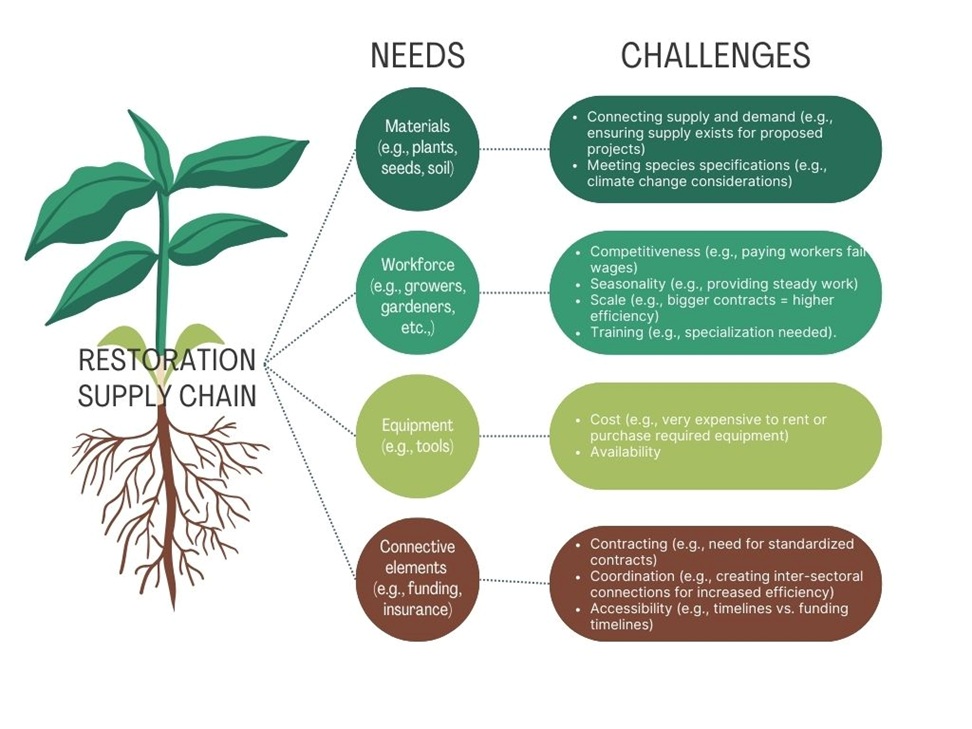
The International Union for Conservation of Nature (IUCN) describes landscape restoration as a “nature-based solution” that “fundamentally [adds] value” through the provision of ecosystem services like bank stabilization and local climate regulation. Despite increasing international recognition that ecological restoration not only boosts the provision of ecosystem services, but also provides opportunities for employment and economic growth,, restoration programs are often underfunded and tend to be deeply impacted by supply chain challenges. Nicole Maness, leader of the Willamette Partnership’s work in habitat conservation, made a presentation at the Institute for Applied Ecology’s Native Plant Materials Conference in 2022 highlighting how “pinch points” in the native seed supply chain can disrupt long-term efficacy of restoration projects, a summary of which is provided in Figure 1. |
Figure 1: Restoration supply chain considerations. Created by Shauna Doll based on ideas shared by Nicole Maness during Native Plant Materials Conference session: “Restoration supply chain: building resilience into our systems” on January 12, 2022 |
Maness’ presentation demonstrated that restoration practitioners and seed suppliers are eager to see a shift toward “local restoration economies”. One benefit of a localized restoration supply chain is higher certainty that native seed supply is ethically sourced and locally appropriate. However, there are many challenges to establishing a self-sufficient restoration system.
Currently, not-for-profit organizations are heavily relied upon to undertake restoration projects; however, they are forced to operate within short-term funding cycles that are out of step with ecological cycles. Meanwhile, many local governments lack the resources and political will to establish in-house native plant nurseries, often resorting to out-of-region and in some cases out-of-province suppliers to source seed stock for planting projects. Although the number of privately-owned native seed suppliers and nurseries is growing in some regions, options are still limited in others. Furthermore, many nurseries still specialize in annuals, ornamentals, and some even continue to sell invasive plant species. Finally, public literacy on the importance of local provenance in seed supply and the value of native species is generally low, which can harm the business case for increasing the number of local native plant nurseries.
The system as it currently exists is unsustainable and insufficient to address the twin biodiversity and climate crises (which continue to be exacerbated by widespread land conversion and degradation). |
The system as it currently exists is unsustainable and insufficient to address the twin biodiversity and climate crises (which continue to be exacerbated by widespread land conversion and degradation). Native plant salvage is one simple but elegant solution to the problem.
HAT's Plant Salvage Program
Habitat Acquisition Trust (HAT) is a small land trust based on southern Vancouver Island on the unceded Territories of lək̓ʷəŋən speaking peoples, which includes the Songhees, W̱SÁNEĆ, and Esquimalt Nations. In 2019, HAT established a volunteer-powered plant salvage program as one way to respond to the scale of habitat loss observed in areas where sensitive ecological communities and rare plants are found within the Capital Regional District (i.e., communities within the greater Victoria region including many of the Gulf Islands). It currently operates on one site near the community of Langford, BC. This opportunity to salvage for native plants was made possible through an agreement with a local developer with the condition that either a HAT staff member is present at the time of salvage or those salvaging have participated in salvage training conducted by HAT.
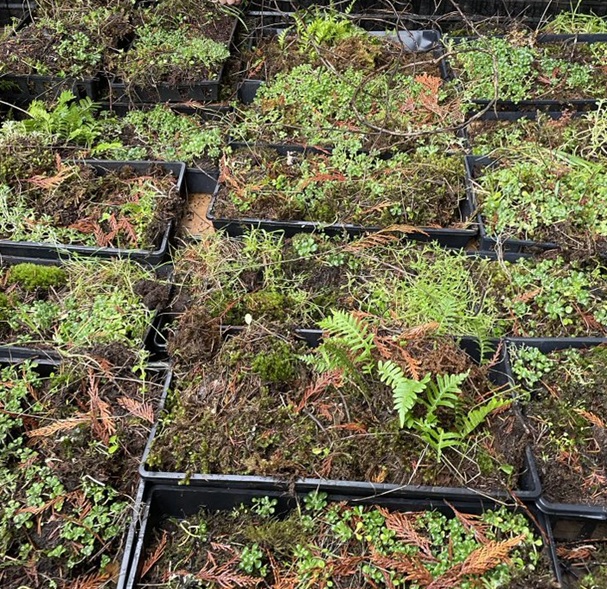
Plants collected during salvage have the potential to be used in local restoration projects. Volunteers are also permitted to keep them, give them to friends, or donate them to a community project or organization. Salvaged plants cannot be sold or used in commercial projects. |
Figure 2: A HAT plant salvage volunteer with a backpack full of native plant treasures. Photo by Paige Erickson-McGee. |
Figure 3: Salvaged plants. Photo by Paige Erickson-McGee. |
It is important to acknowledge that native plant salvage is a last-ditch effort to save biodiversity from a site that would otherwise be destroyed. While it would be preferable to safeguard local biodiversity through longer-term land stewardship solutions, which may include Indigenous Protected and Conserved Areas (IPCAs), tribal parks, and/or conservation covenants, unfortunately some degree of land conversion is challenging to avoid, especially in cities. Native plant salvage is just one tool available in an arsenal of approaches to protect and enhance local biodiversity. It is best used in complement to other efforts to: remove barriers to establishing a functional native seed supply chain (e.g., establishments of local native plant nurseries), protect intact habitats (e.g., establishment of parks and protected areas), and improve development policies and practices (e.g., limiting new development in greenfield sites, requiring smaller physical and environmental footprints of new developments), among other restoration and conservation approaches.
Establishing a Native Plant Salvaging Program
To help guide those interested in establishing a plant salvage program, the management details of HAT’s program are outlined below.
HAT typically hosts two salvage training days per year, one in the spring and one in the fall. Anyone interested in contributing to the plant salvaging effort must attend one of these sessions. In southern BC, fall salvaging causes less stress for the plants and thus is a better time to salvage. However, spring is an easier time to accurately identify many flowering plants so it may be a better time for those less familiar with local species to practice salvaging. It is important to plan salvaging events according to what is seasonally appropriate.
A waitlist form is always open on the HAT website for those interested in being trained to salvage plants. Once a training event is planned, a registration form is sent to everyone on the waitlist. The site location and other important information are only shared once people have registered to prevent untrained people from accessing the site. Participants are also sent a waiver and code of ethics to review in advance of the event. |
Once registrants have been trained and signed all forms, they are awarded with a salvage permit, which they must always keep on their person when visiting the salvage site.
Approximately half the training time is dedicated to discussing ethics, the code of conduct, and site safety information. The other half is spent salvaging. During the second half, trainers guide plant identification and share techniques for transplanting different species. Once training is complete, all participants have the option to join a private Facebook group where they can plan salvaging days and share resources, expertise, and plants.
Trained salvagers then have access to the salvage site so long as they follow the restrictions set by HAT in agreement with the developer. This means only accessing the site during specific hours. Additionally, no one is permitted to salvage alone, they must always be accompanied by at least one other person who has also completed the training. Finally, salvagers must check in and out with a developer contact upon arrival and departure from the site.
Important forms and resources that will likely be required for any plant salvage program include:
-
Waiver
-
Site-specific code of ethics
-
A short document generally developed in collaboration between the site owner/developer and the organizer of the plant salvaging initiative which outlines community agreements for behaviour while on site ensuring proper treatment of people, place, and plants.
-
Site orientation document with maps of salvage areas, parking, times and days for site access
-
Salvage permit
-
Volunteer database
-
Plant ID and restoration guide(s)
|
Conclusion
The objectives of a native plant salvaging program are simple, but their delivery can be challenging. Project success depends on strong relationships. The very existence of a native plant salvage program hinges on access permission from a landholder/developer. The code of ethics is an essential tool to reduce the likelihood of conflict and ensure that this relationship stays positive. Likewise, strong relationships are needed between organizers and volunteers to establish program longevity and success. Finally, it may be worth exploring the establishment of a plant salvage program in collaboration with another like-minded organization or local government. These kinds of programs often hinge on the involvement of a few dedicated people, without whom they can become impossible to upkeep. Collaborative effort shares the load and may help open doors to new places for relocated plants to find their forever habitat. |
RCEN supports ENGOs and individuals by providing valuable networking, communications, and resource-sharing services. From coast to coast, we collaborate on bold, positive, and future-focused solutions to the climate crisis. Our Biodiversity Caucus, in particular, plays a pivotal role in linking local and global efforts to protect and enhance biodiversity. By joining the Biodiversity Caucus, you can directly contribute to implementing the Convention on Biological Diversity (CBD), raising awareness, building capacity, and encouraging proactive action.
→ Get involved with the Biodiversity Caucus and make a difference!
→ Follow RCEN on Facebook, LinkedIn, and Instagram.
→ Become a member of RCEN and join the network! |
|
|
.jpg)




.jpg)
.jpg)